01AI
An autonomous software repair agent that reproduces bugs, generates fixes, verifies them in isolation, and proves the repair with execution evidence.

Overview
GhostFix AI is an autonomous software repair agent built around one principle: don't just generate a fix — prove it works.
Instead of trusting an AI-generated patch because it looks correct, GhostFix first reproduces the real failure, uses NVIDIA Nemotron through Nebius Token Factory to reason about the bug, generates a candidate repair, and verifies that repair inside an isolated Docker environment.
A repair is only marked VERIFIED when the required execution evidence passes.
Evidence-driven self-correction
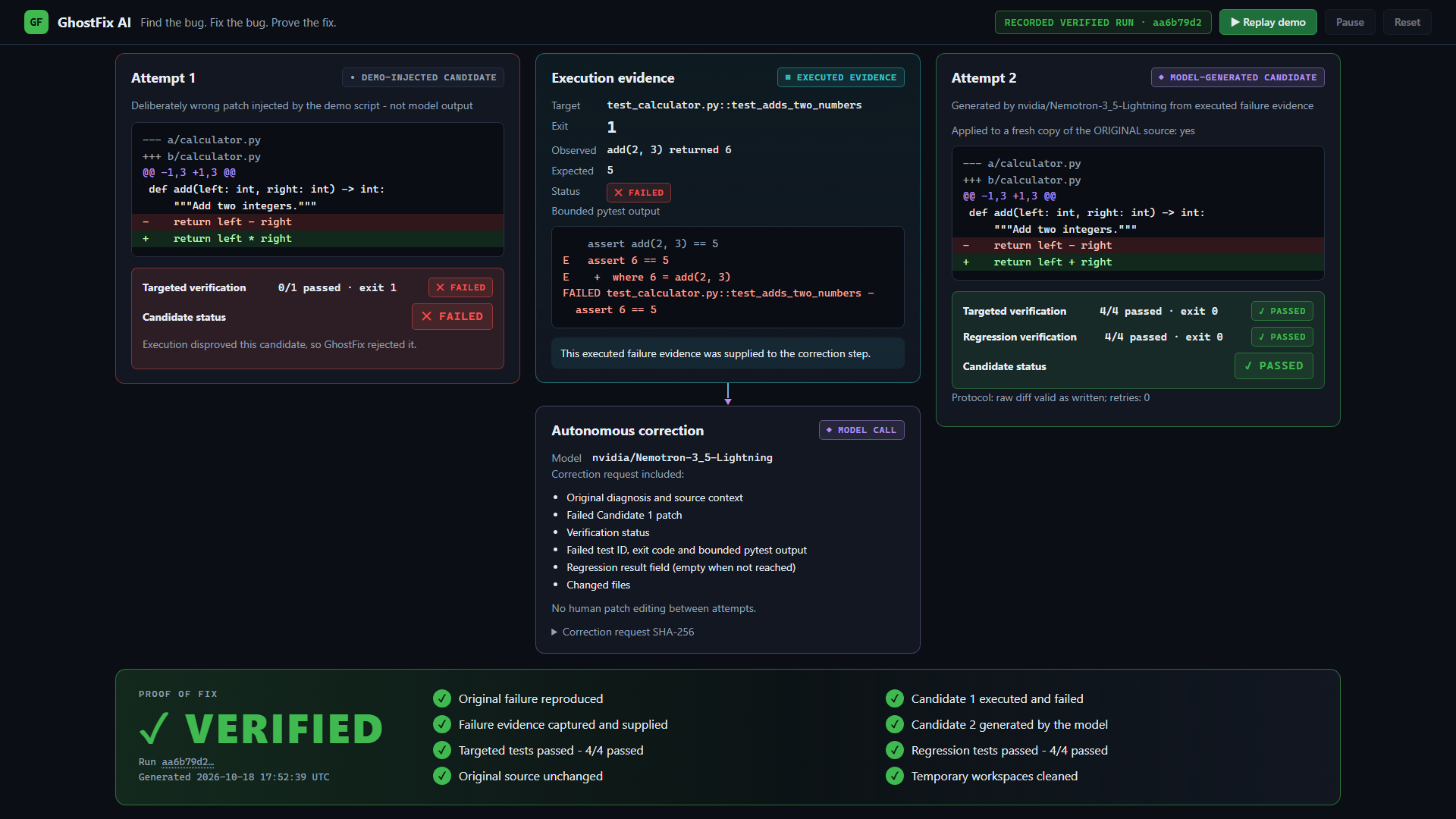
GhostFix does not assume that a plausible-looking patch is correct.
In the controlled self-correction demo, the first candidate is deliberately injected as a safe but intentionally incorrect patch. This is clearly disclosed as demo-injected rather than model-generated.
GhostFix executes the candidate inside an isolated Docker sandbox, where the targeted test genuinely fails. That real execution failure becomes structured evidence for the correction step.
Autonomous correction
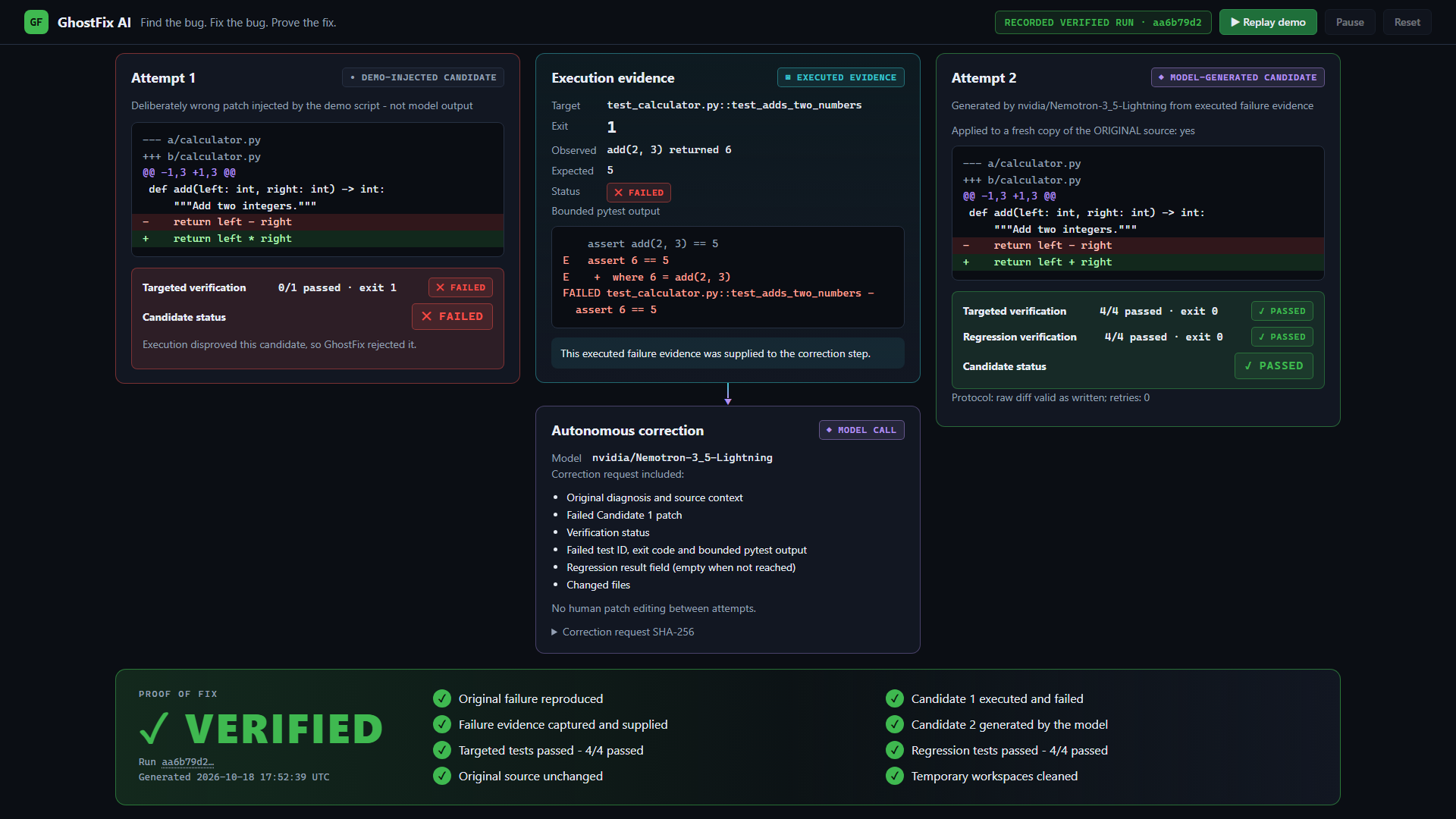
The failed execution is converted into bounded correction evidence and supplied back to Nemotron.
Nemotron generates a second candidate from that evidence, and GhostFix starts verification again from the original approved source. There is no human patch editing between the two attempts.
This time, the targeted tests pass and the regression suite passes. Model confidence does not determine success — executed tests do.
Proof of Fix
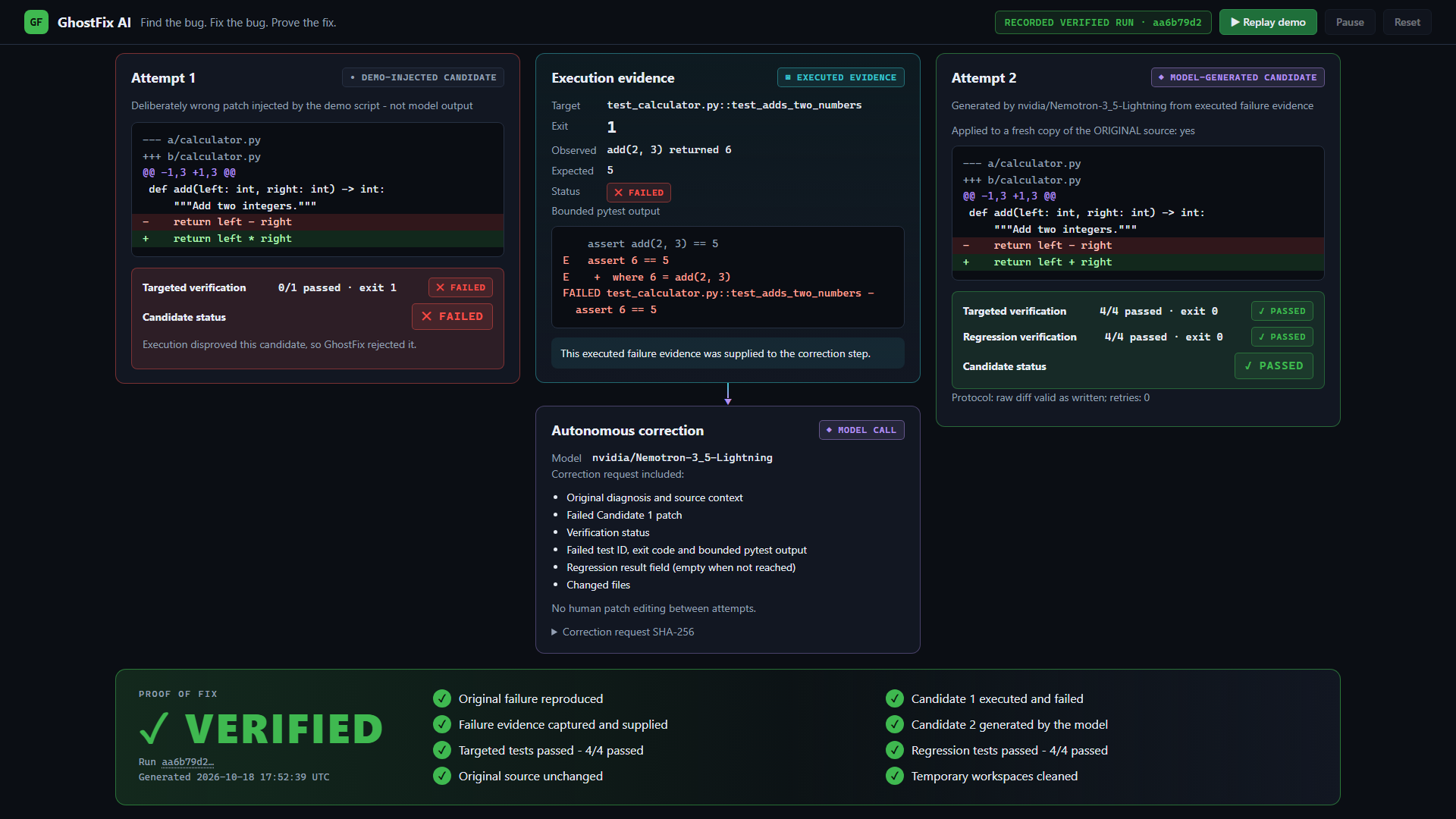
A successful repair produces a deterministic Proof of Fix that records the evidence behind the final result.
It preserves the original failure reproduction, repair trajectory, verification results, provenance, and integrity information. Model-generated diagnoses remain explicitly labeled as hypotheses, while executed test results are treated separately as evidence.
GhostFix only reports VERIFIED when the required evidence is satisfied. A convincing patch or high model confidence alone is never enough.
Engineering evaluation
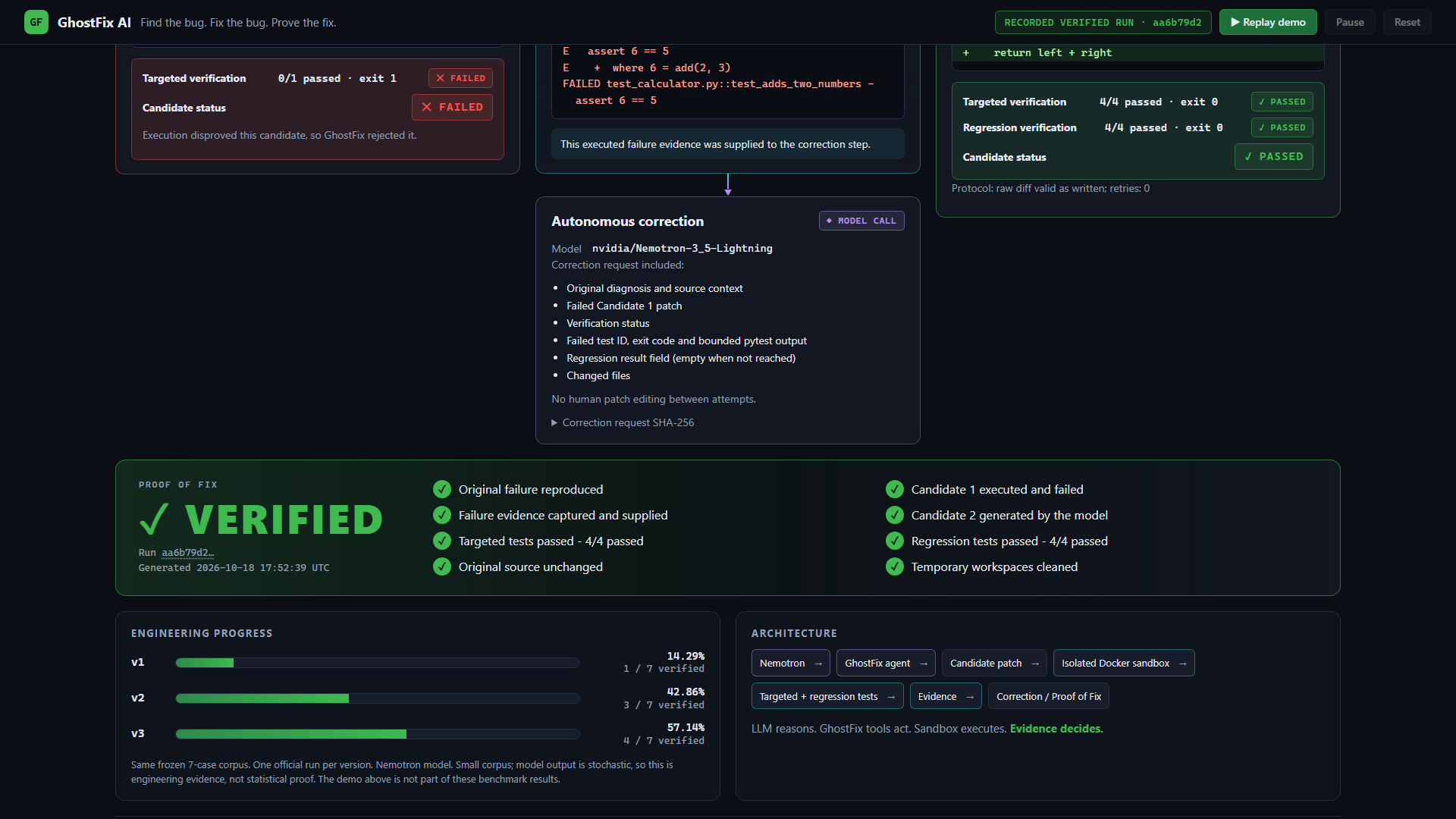
I evaluated GhostFix on a frozen seven-case engineering benchmark designed to test repair reliability across different bug patterns.
Verified repairs improved from 1/7 in v1, to 3/7 in v2, and 4/7 in v3 as the repair and patch-handling pipeline improved.
Because this is a small frozen benchmark, I treat these results as engineering evidence, not as a universal software-repair success rate.
Nebius × NVIDIA Global AI Hackathon 2026
GhostFix AI was built for the Coding and Agentic Engineering track of the Nebius × NVIDIA Global AI Hackathon 2026.
The runtime uses NVIDIA Nemotron through Nebius Token Factory for model reasoning, while deterministic Python tooling, Docker isolation, and pytest control execution and verification.
The architecture follows a simple rule:
The LLM reasons → GhostFix tools act → the sandbox executes → evidence decides.
Next project
PrepWise